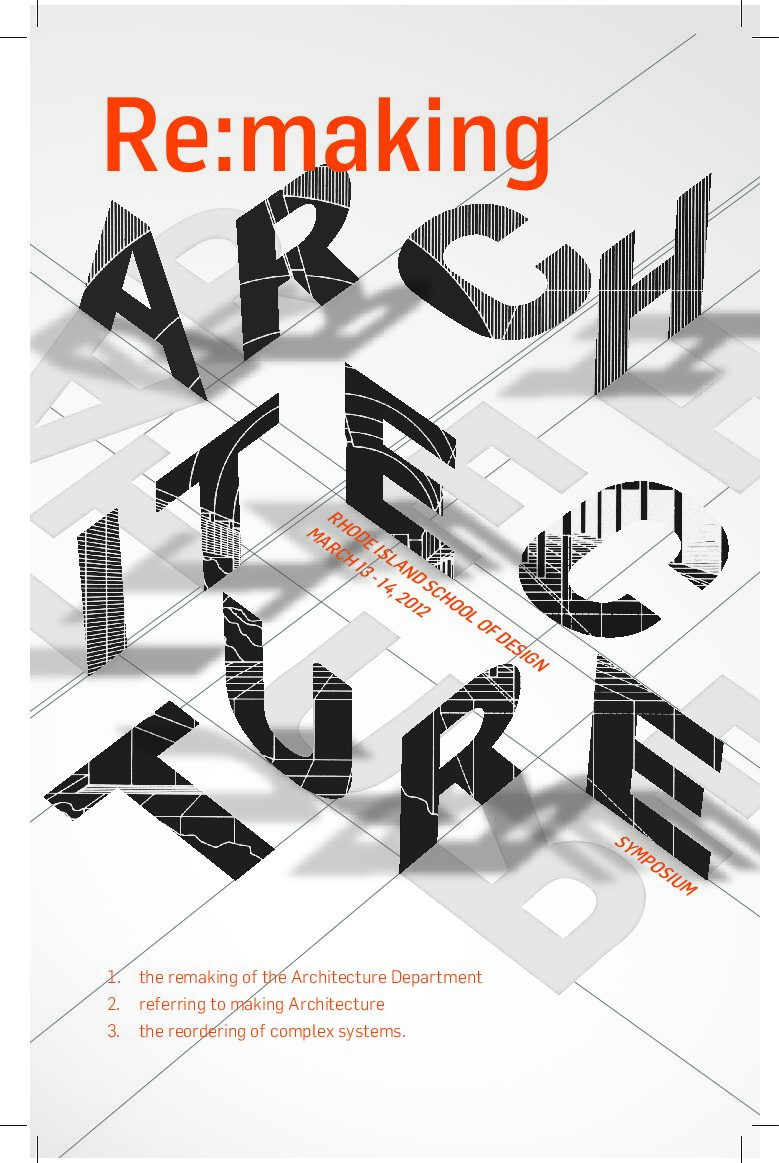
Back in 2012, as Head of the Department of Architecture, I organized a Symposium called “RE:making Architecture.
We made a digital archive of work from the Architecture Department since its inception, mounted a show in the gallery, made videos of a selection of RISD Architecture Alumni and had two days of presentations and discussions by speakers who got us thinking in new ways about learning.
Bios of Invited Speakers
Eleanor Ruth Duckworth, PhD., is a cognitive psychologist, educational theorist and
constructivist educator. A former student, colleague, leading translator and interpreter of
Jean Piaget as well as renowned Professor of Education at Harvard Graduate School of
Education, she is one of the leading progressive educators today. Duckworth earned her
Ph.D. (Docteur en sciences de l’éducation) at the Université de Genève in 1977. A former
student and translator of Jean Piaget, she grounds her work in Piaget and Inhelder’s
insights into the nature and development of understanding and in their research method,
which she has developed as a teaching/research approach, Critical Exploration in the
Classroom. Her interest is in the experiences of teaching and learning of people of all
ages, both in and out of schools. Duckworth is a former elementary school teacher and
has worked in curriculum development, teacher education, and program evaluation in the
United States, Europe, Latin America, Africa, Asia, and her native Canada. She is a
coordinator for Cambridge United for Justice with Peace, and is a performing modern
dancer. Eleanor Duckworth is the author of several books including The Having of
Wonderful Ideas: And Other Essays on Teaching and Learning and “Tell Me More”:
Listening to Learners Explain.
Elliot Washor, Ed.D. is the co-founder and co-director of Big Picture Learning. He is also
the co-founder of The Met Center in Providence, RI. Elliot has been involved in school
reform for more than 30 years as a teacher, principal, administrator, video producer, and
writer. He has taught and is interested in all levels of school from kindergarten through
college, in urban and rural settings, across all disciplines. His work has spanned across
school design, pedagogy, learning environments, and education reform and is supporting
others doing similar work throughout the world. Elliot’s interests lie in the field of how
schools can connect with communities to understand tacit and disciplinary learning both
in and outside of school. Elliot is deeply committed to imagining Big Picture Learning as a
‘do-think-do’ organization, and persistently pushes the boundaries of its design in order to
continually innovate practice and influence in the world of education.
Thomas Ewens, PhD., is Professor Emeritus of Philosophy at RISD, former Dean
of the Division of Fine Arts and practicing psychoanalyst. He served as Executive
Director of the Syracuse Consortium for the Cultural Foundations of Medicine and
the Director of the Center for Twentieth Century Studies. Dedicated to community
progress, he has served on the Boards of Director for the Providence Haitian
Project and Humanities Forum of Rhode Island and organized Project Esperanza,
a program in which high school students work alongside impoverished
Dominicans building clinics, etc. As General Editor for the Theories of
Contemporary Culture series published by Coda Press, he applies his insight into
arts education, psychology and philosophy in his publications and lectures. A
recipient of grants and awards from the National Endowment for the Humanities,
he is a member of the American Philosophical Association, the Belgian School of
Psychoanalysis, the Society for Existential and Phenomenological Philosophy and
International Development Ethics Association.
Frank R. Wilson, M.D., is a neurologist/writer who has been an internationally respected
authority on the neurological basis of skilled hand use for over two decades. Now retired
from active clinical practice, he was a founder of the Health Program for Performing
Artists at the University of California San Francisco, and its medical director from 1996-
- He was Visiting Professor of Neurology at the University of Dusseldorf in 1989-
1990, Associate Clinical Professor of Neurology at the University of California, San
Francisco until 2000, and Clinical Professor of Neurology at Stanford University Medical
Center until 2004. He has long been interested in the neurology of skilled hand
movement, and is a widely respected authority on the neurology of acquired hand
disorders. He is the author of two monographs on the hand: Tone Deaf and All Thumbs:
an invitation to music-making for late bloomers and non-prodigies (Viking-Penguin, 1986)
and The Hand: How its use shapes the brain, language, and human culture, published in
1998 by Pantheon books. In this landmark book, Frank R. Wilson makes the claim that it
is because of the unique structure of the hand and its evolution in cooperation with the
brain that Homo sapiens became the most intelligent, preeminent animal on the earth.
Sung Ho Kim, Architect/ Educator and RISD Alumnus is Principal of Axi:Ome LLC of St.
Louis, working on various commissioned projects. Two monographs about
Axi:Ome—Spatial Practice (Oro Editions) and Specular: Between Practice and Education
(Damdi Architecture Publishing Co.)—were published in 2009. Sung Ho Kim has taught
at Rhode Island School of Design and was Assistant Professor of Architecture at
Northeastern University. He has worked as a designer for Nasrine Seraji in Paris, France,
and Wellington Reiter in Cambridge, Massachusetts. He was a principal researcher for
Krzysztof Wodiczko’s Interrogative Design Group at the Center for Advanced Visual
Studies at MIT. He is currently Associate Professor of Architecture at Washington
University in St. Louis and coordinates the Digital Media Curriculum.
Richard Saul Wurman is an architect and graphic designer who is a pioneer in the
practice of making information easily understandable. Wurman has written and designed
over 80 books, and created the TED conferences. Wurman coined the phrase
“information architect” in response to the large amount of information generated in
contemporary society, which is often presented with little care or order. Wurman created
the popular ACCESS travel guide books, which were innovative in their use of mapping
content by neighborhood. With this series of books, Wurman firmly established the
purpose of information architecture. Wurman has been awarded several grants from the
National Endowment for the Arts, a Guggenheim Fellowship, two Graham fellowships,
and two Chandler fellowships. He was made an AIA Fellow in 1976 and entered the Art
Directors Club Hall of Fame in 2003. He was a 2004 Medalist of the AIGA – formerly the
American Institute of Graphic Arts –which honored him as a design conference
impresario. He is a Senior Fellow of the Design Futures Council.
Kevin Kelly is Senior Maverick at Wired magazine. He co-founded Wired in 1993, and
served as its Executive Editor from its inception until 1999. He is also editor and publisher
of the Cool Tools website, which gets half a million unique visitors per month. From 1984-
1990 Kelly was publisher and editor of the Whole Earth Review, a journal of unorthodox
technical news, the first consumer magazine to report on virtual reality, ecological
restoration, the global teenager, Internet culture and artificial life. In the late 80s, Kelly
conceived and oversaw the publication of four versions of the Whole Earth Catalogs the
award-winning compendiums evaluating all the best “tools” available for self-education
including hardware, power tools, books, and software — anything that leverages power to
individuals. In 1988 Kelly edited, published, and wrote much of Signal, a Whole Earth
Catalog of personal communication tools, which evaluated the technologies of faxes,
satellite TV, cellular, digital retouching, online systems and the whole emerging world of
digital technology. Kelly was also co-founder of the annual Hackers’ Conference, a
weekend rendezvous which in 1984 brought together three generations of legendary
computer programmers for the first time. Kevin was involved with the launch of the
WELL, a Sausalito-based teleconferencing system started in 1985. It currently has
10,000 members. Kelly is the author of Out of Control: The New Biology of Machines,
Economic and Social Systems, published by Addison Wesley (1994). This wide-ranging
book is about how machines, the economy, and all large human-made inventions are
becoming biological. His second book, New Rules for the New Economy, was published
in 1998 by Viking/Penguin in the US and by 4th Estate in the UK. His most recent book is
What Technology Wants, published in 2010 by Viking/Penguin. He has no college or university degree.