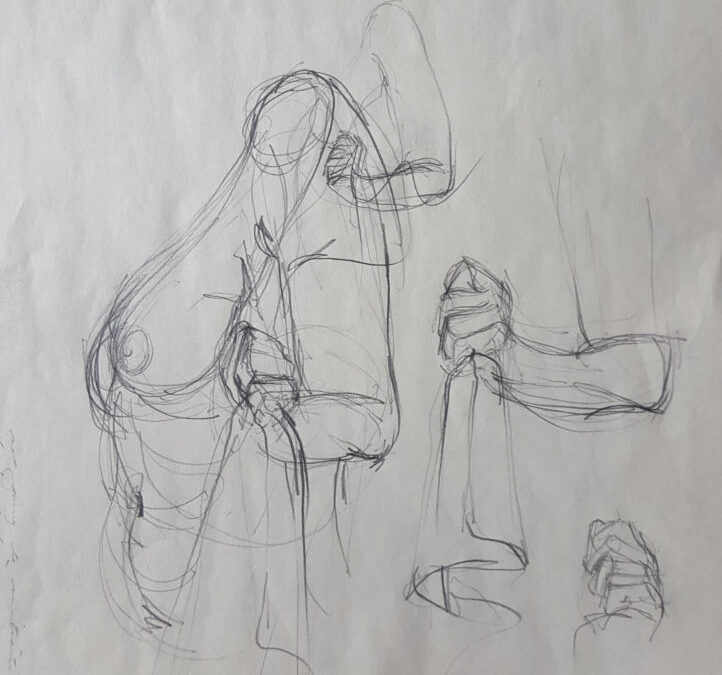
Drawing is understood through its origin, to pull or extract. Extracting or pulling are motions from and towards. This idea of drawing is more specific than the generic image; as in, drawing out from the imagination or memory to the page or drawing from the world through the author to the page. Both writing and drawing are pulled to the page from their shared Greek origin, graphikos, or “for writing, belonging to drawing.” Drawing inherently is a bridge between author and world, conscious and unconscious, here/now and a projection towards there/then. Drawing propels design as it carries forward through its purposeful role as a language of expression and articulation of thought.
In addition to extraction, drawing also contains a sense of attraction as in “to draw a crowd.” The force of attraction inherent in drawing is related to the act of tracing. Tracing, tracking, and trait are all etymologically associated with tract, which comes from the Latin root trahere, the past participle of tractus, the action of drawing (along) and the act of drawing. The French word trait is used to refer to an act of drawing, specifically “a stroke in the delineation of character.” It is a process of tracking, a dynamic pursuit that is continually being updated through the feedback that is drawn up. It clarifies and guides us to make editorial decisions.

Tracking involves oscillating about an abstraction. Abstraction means to draw away from (ab = away from + tract = draw). The abstract ideal or goal is pulled away from, distinguished from the clutter of all the context of the problem. The periodic oscillation in the feedback control function of a thermostat is an example of tracking. It becomes the standard for the form, which is the “definiteness” of the idea or goal.
The idea of a search with feedback, an oscillation around an “intended” outcome is analogous to the reiterative cycle of projecting/making/feedback/reflection/critique of creative practice. This reiterative process is an oscillation of author, work, world, and intention. It simultaneously absorbs, propels, corrects, and posits. And thus, drawing propels design.
April 24, 2019