The carefully curated archive, drawing matter and documentary filmmakers Muffy Meyer and Susan Froemke (their film, “The Opera House”) have included and correctly attributed my father’s sketch (shown in the post immediately following this one, entitled: “Post on drawing.matter.org”, October 15, 2021) and his work as a designer for Wallace K. Harrison. Yet there still is some confusion by certain circles of New York society that incorrectly attribute this sketch to Lobmeyr who fabricated the chandeliers. In an effort to help understand a chapter of my father’s career as the right hand for WKH, and specifically how his concept sketch came about, I made a website compiling some of the information.
Some background: my father worked at Harrison & Abramovitz from 1954 to 1972. In 1960, Wallace K. Harrison sold my father a sizable (2+ acres) of land adjacent to his own estate on Round Swamp Road in Huntington Long Island.
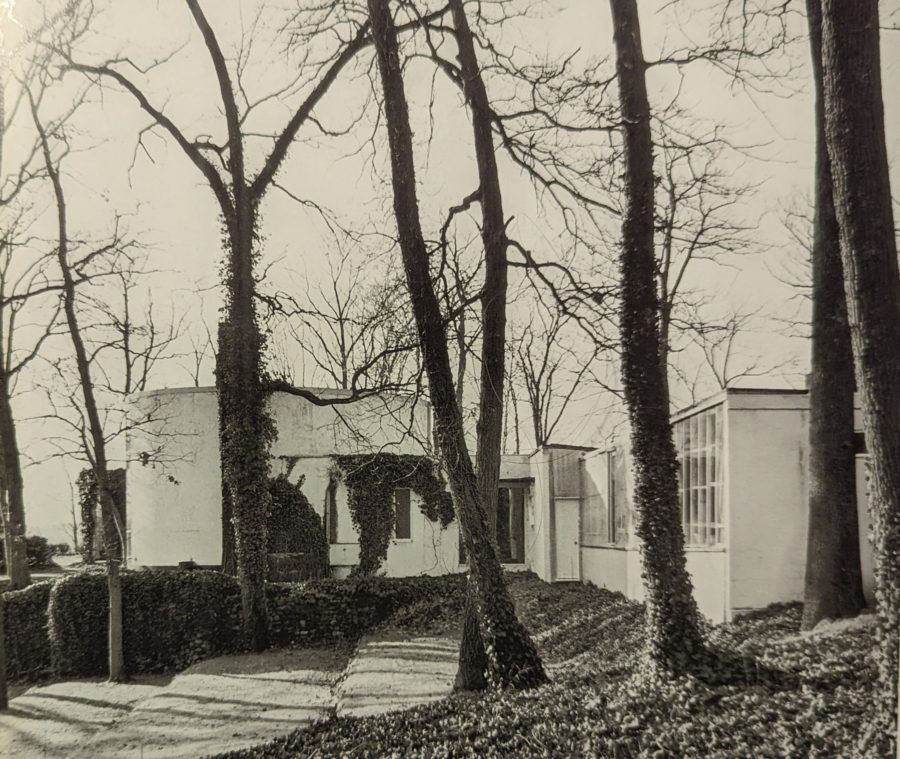
WK Harrison House 1932-1970
This is where my father designed and built a home for my family and where I grew up. It had an orchard that Ellen Harrison planted during the war and rose to woods (the same that Walt Whitman walked) that is the highest point of Long Island. W.K.H. used his house and studio as an escape from the city office where both he and my father worked everyday.
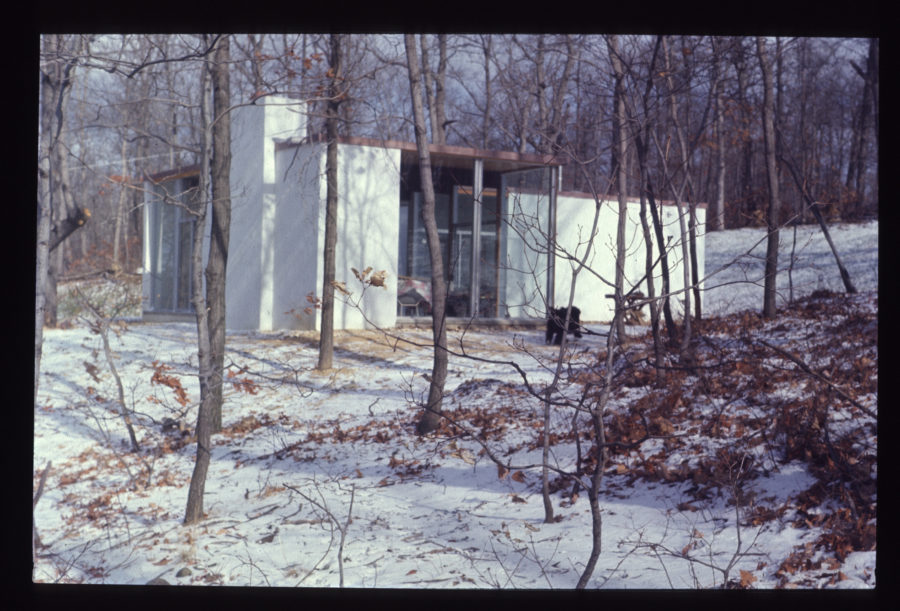
Leski House 1966
Both he and my father worked at home in their neighboring properties with old clothes–the pants tied with rope. Both men liked to paint. My father would make sketches, renderings and paintings in his studio in our basement (and sometime on the living-room floor) and WKH in his cylindrical studio. I think that Wallace K. Harrison had enormous respect for my father’s talent and kept him close both in the Harrison & Abramovitz Office in Rockefeller Center and at their Huntington homes. Although WKH mingled with the most rich and powerful, he came from humble beginnings. It was not the practice of the times to formerly credit designers; but, he appreciated the talent and ideas of my immigrant father. This may be difficult for the NY Society to understand; hence, the “confusion.”
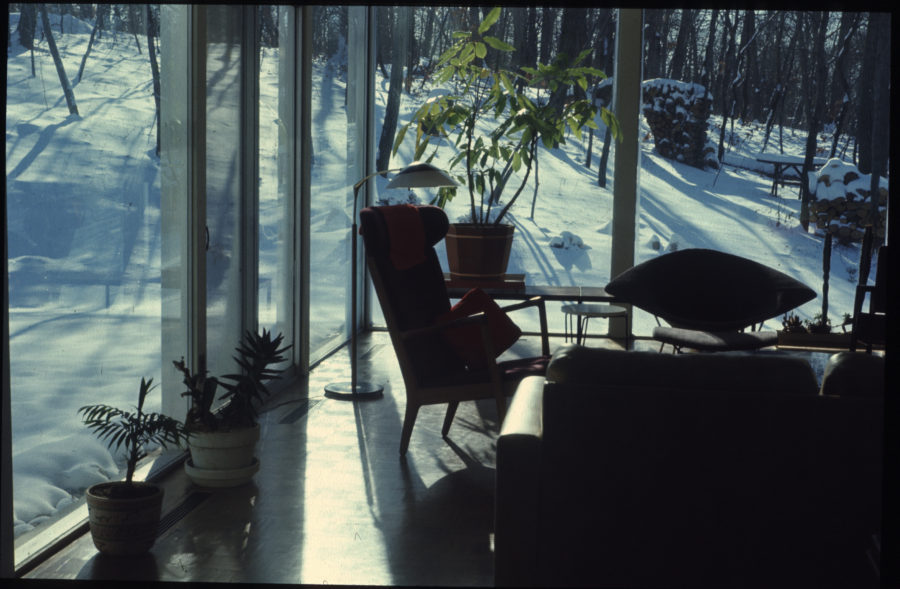
Leski House interior 1966